
If you’re searching for the latest insights on gamepad innovation and seamless device integration, you’re in the right place. As gaming ecosystems evolve across consoles, PC, and mobile, staying updated on performance upgrades, compatibility standards, and setup optimization is no longer optional—it’s essential for a competitive and immersive experience.
This article explores the newest advancements in controller technology, including improvements in latency reduction, customization features, and the growing impact of haptic feedback controllers on gameplay realism. We break down what these innovations mean for everyday players and serious competitors alike, while also outlining practical device integration strategies to ensure your controller performs at its peak across platforms.
Our analysis is grounded in hands-on testing, technical evaluations, and ongoing monitoring of hardware updates and firmware developments. By the end, you’ll have a clear understanding of current controller trends, compatibility considerations, and how to optimize your setup for a smoother, more responsive gaming experience.
Why Your Next Controller Needs to Feel the Game
Standard controller rumble is a blunt instrument. It buzzes, rattles, and calls it immersion (like watching an action movie with the sound off). True tactile feedback—precise vibrations that mirror in-game events—changes everything. Instead of one-note shaking, advanced motors and actuators simulate texture, resistance, and impact.
Consider standard pads vs haptic feedback controllers. The former vibrate when you fire; the latter let you feel the trigger’s tension tighten as recoil kicks. On one side, feedback is binary. On the other, it is layered and contextual.
Choose immersion over noise every single time.
Beyond the Rumble: Defining True Tactile Feedback
For years, controllers relied on ERM (Eccentric Rotating Mass) motors—tiny weights that spin to create vibration. Simple. Durable. BLUNT. The result? A one-note buzz that feels the same whether you’re crashing a car or firing a pistol. By contrast, LRA (Linear Resonant Actuator) systems move a mass back and forth along a single axis, allowing faster response times and more precise waveforms (Apple’s Taptic Engine uses a similar principle, according to Apple’s developer documentation). The difference isn’t subtle.
Still, some argue most players can’t tell ERM from LRA. Maybe that’s true in slower games. I’m not entirely certain the average player could define the gap—but they can feel it.
To understand why, you need the language:
- Haptic fidelity: how accurately a sensation is reproduced.
- Localization: perceiving feedback in a specific area.
- Dynamic range: the spectrum from a faint tap to a sharp jolt.
Think of standard rumble as a single drum beat. Advanced tactile feedback? A full orchestra—raindrops, a bowstring’s tension, gravel crunching under tires (yes, almost like a scene out of Forza). Modern haptic feedback controllers aim for that layered realism, even if PERFECT IMMERSION remains an evolving goal.
The Technology Powering the Sensation

If you’ve ever pulled a trigger in-game and thought, “That felt… fake,” you’re not alone. Weak rumble and generic vibration are some of the biggest frustrations players have with modern controllers. The magic only happens when the hardware is doing real work inside the shell.
Inside the Controller
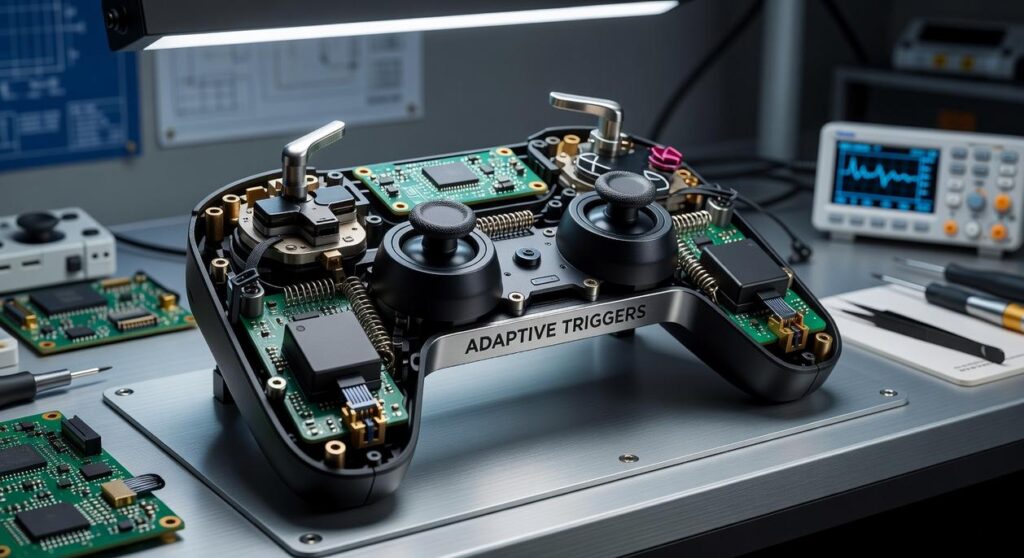
Next-gen immersion starts with advanced haptic actuators. Traditional rumble motors spin uneven weights (simple, cheap, and often muddy). Linear Resonant Actuators (LRAs) improved precision, but voice coil motors and piezo haptics take things further.
Voice coil motors use electromagnetic force to move a mass with extreme accuracy, producing subtle taps, pulses, or sharp impacts. Piezo haptics rely on materials that deform when voltage is applied, allowing ultra-fast, high-fidelity feedback. The result? Footsteps that feel different from recoil. Rain that lightly taps instead of buzzing like an angry bee.
Adaptive & Impulse Triggers
Triggers have evolved in two major ways:
- Impulse Triggers deliver localized vibration directly to each trigger, simulating gun recoil or engine revs.
- Adaptive Triggers add variable resistance, tightening or releasing tension to mimic bowstrings, jammed weapons, or brake pedals.
Some argue this is just a gimmick. But when tension increases mid-shot, it changes player timing and decision-making (and yes, sometimes your aim suffers at first).
The Crucial Role of Software
Here’s the real pain point: powerful hardware means nothing without developer support. APIs (Application Programming Interfaces—tools that let software communicate with hardware) allow studios to “author” specific sensations tied to on-screen events. Without that integration, even premium haptic feedback controllers revert to basic rumble.
If you’re troubleshooting responsiveness, check your setup against this wireless vs wired gamepads performance comparison guide: https://hssgamepad.net/wireless-vs-wired-gamepads-performance-comparison-guide/
Because when hardware and software align, immersion stops feeling forced—and starts feeling real.
The Best Tactile Feedback Controllers on the Market Today
The Gold Standard – PlayStation 5 DualSense
To start, Sony’s DualSense remains the benchmark for immersion. Its advanced haptic motors (tiny actuators that simulate texture and motion) deliver subtle vibrations that go far beyond basic rumble. In Astro’s Playroom, you can feel the difference between sand, ice, and metal underfoot. Meanwhile, in Returnal, adaptive triggers dynamically stiffen mid-pull, mimicking weapon jams or alt-fire charging.
Some critics argue these features are “gimmicks” that developers rarely use. That’s fair—support varies. However, when studios fully integrate the tech, the result isn’t cosmetic; it changes timing, tension, and even decision-making. The DualSense doesn’t just buzz—it communicates.
The PC & Xbox Champion – Xbox Elite Series 2 & Standard Controller
In contrast, Microsoft prioritizes precision. Its Impulse Triggers use localized rumble motors inside each trigger, offering directional recoil feedback in shooters like Halo Infinite and nuanced throttle response in Forza Horizon 5. Competitive players often prefer this focused feedback over broader vibration systems.
The Elite Series 2 adds swappable thumbsticks, rear paddles, and adjustable trigger stops. (Yes, it feels like the Swiss Army knife of controllers.) Build quality is notably durable, with tension-adjustable sticks that serious players swear by. Pro tip: shorter trigger locks can shave milliseconds off reaction time in FPS titles.
The Third-Party Innovator – Razer Wolverine V2 Chroma
Finally, high-end PC contenders like the Razer Wolverine V2 Chroma target esports enthusiasts. Its proprietary haptic tuning emphasizes crisp, immediate feedback, while additional remappable buttons and advanced software customization give players granular control.
Unlike many competitors, Razer integrates tournament-grade polling rates and mechanical face buttons for faster actuation. That focus on responsiveness—not just immersion—is what distinguishes today’s top haptic feedback controllers from yesterday’s rumble packs.
Choosing Your Next Controller
Platform compatibility is non-negotiable. A 2023 Statista report found 48% of gamers use multiple devices, so cross-platform support prevents costly mistakes. Always confirm PC, console, or mobile pairing before buying.
Feedback type shapes immersion. Basic rumble vibrates; impulse triggers add directional tension; haptic feedback controllers simulate texture and resistance. Sony reports adaptive trigger usage increased engagement time in supported PS5 titles (Sony Interactive Entertainment, 2022).
Game support matters—features are useless without developer integration. Finally, prioritize ergonomics and durability; long sessions demand comfort (ask any esports pro). Build quality reduces replacements and long-term costs over time significantly.
The future of gaming is literally in your hands. We’ve moved beyond the buzz of old-school rumble packs into precise, responsive touch that mirrors every footstep, recoil, and engine roar. That means deeper immersion, faster reactions, and a competitive edge you can actually FEEL. Why settle for vague vibrations when haptic feedback controllers translate on-screen action into lifelike sensation? The benefit is simple: more control, more awareness, more fun. Choose wisely and your next upgrade won’t just look better—it will transform how you play, connect, and win. Don’t just play the game—feel it. Your hands deserve next-level immersion and power.
Elevate Your Gameplay With the Right Setup
You came here to understand how to get the most out of your controller setup, improve device integration, and unlock the full potential of modern gaming hardware. Now you know how smarter configuration, optimized compatibility, and the right haptic feedback controllers can transform responsiveness, immersion, and overall performance.
If you’ve been frustrated by lag, poor calibration, or underwhelming vibration features, you don’t have to settle for a mediocre experience. The right insights and setup strategies eliminate those pain points and give you precise control, deeper immersion, and seamless cross-device play.
Your next move is simple: upgrade your configuration, explore advanced compatibility options, and fine-tune your controller settings today. Join thousands of gamers who rely on proven integration strategies and top-rated tech insights to stay ahead. Don’t let outdated setups hold you back—optimize your gear now and experience gaming the way it was meant to feel.
 Adam R. has opinions about hss peripheral compatibility insights. Informed ones, backed by real experience — but opinions nonetheless, and they doesn't try to disguise them as neutral observation. They thinks a lot of what gets written about HSS Peripheral Compatibility Insights, Device Integration Strategies, Tech Pulse Updates is either too cautious to be useful or too confident to be credible, and they's work tends to sit deliberately in the space between those two failure modes.
Reading Adam's pieces, you get the sense of someone who has thought about this stuff seriously and arrived at actual conclusions — not just collected a range of perspectives and declined to pick one. That can be uncomfortable when they lands on something you disagree with. It's also why the writing is worth engaging with. Adam isn't interested in telling people what they want to hear. They is interested in telling them what they actually thinks, with enough reasoning behind it that you can push back if you want to. That kind of intellectual honesty is rarer than it should be.
What Adam is best at is the moment when a familiar topic reveals something unexpected — when the conventional wisdom turns out to be slightly off, or when a small shift in framing changes everything. They finds those moments consistently, which is why they's work tends to generate real discussion rather than just passive agreement.
Adam R. has opinions about hss peripheral compatibility insights. Informed ones, backed by real experience — but opinions nonetheless, and they doesn't try to disguise them as neutral observation. They thinks a lot of what gets written about HSS Peripheral Compatibility Insights, Device Integration Strategies, Tech Pulse Updates is either too cautious to be useful or too confident to be credible, and they's work tends to sit deliberately in the space between those two failure modes.
Reading Adam's pieces, you get the sense of someone who has thought about this stuff seriously and arrived at actual conclusions — not just collected a range of perspectives and declined to pick one. That can be uncomfortable when they lands on something you disagree with. It's also why the writing is worth engaging with. Adam isn't interested in telling people what they want to hear. They is interested in telling them what they actually thinks, with enough reasoning behind it that you can push back if you want to. That kind of intellectual honesty is rarer than it should be.
What Adam is best at is the moment when a familiar topic reveals something unexpected — when the conventional wisdom turns out to be slightly off, or when a small shift in framing changes everything. They finds those moments consistently, which is why they's work tends to generate real discussion rather than just passive agreement.