Remember the buzz from an old controller? That vague, generic rumble? It felt more like a polite nudge than anything immersive.
Today’s gaming? It’s transformed. Haptic feedback gamepads don’t just buzz; they whisper, shout, even sing through your fingers, making you feel every digital pulse.
Most gamers think tactile response is just a gimmick. Wrong. We’re diving deep into why these features matter, unraveling technology that shifts gaming from simple play to true immersion.
This isn’t fluff. We’ve researched the tech and its benefits, and you’ll see how these controllers redefine virtual worlds. Ready to discover gaming’s new era?
Beyond the Buzz: Tactile Response Technology Uncovered
Let’s talk tactile response. Imagine the old rumble tech as a sledgehammer (sure,) it gets the job done, but it’s not subtle. Enter haptic feedback: the scalpel of gamepads.
It’s precise. You feel every nuance, from a gentle tap to a firm jolt. Now, haptic feedback isn’t just a fancy way to say, “your controller shakes.”
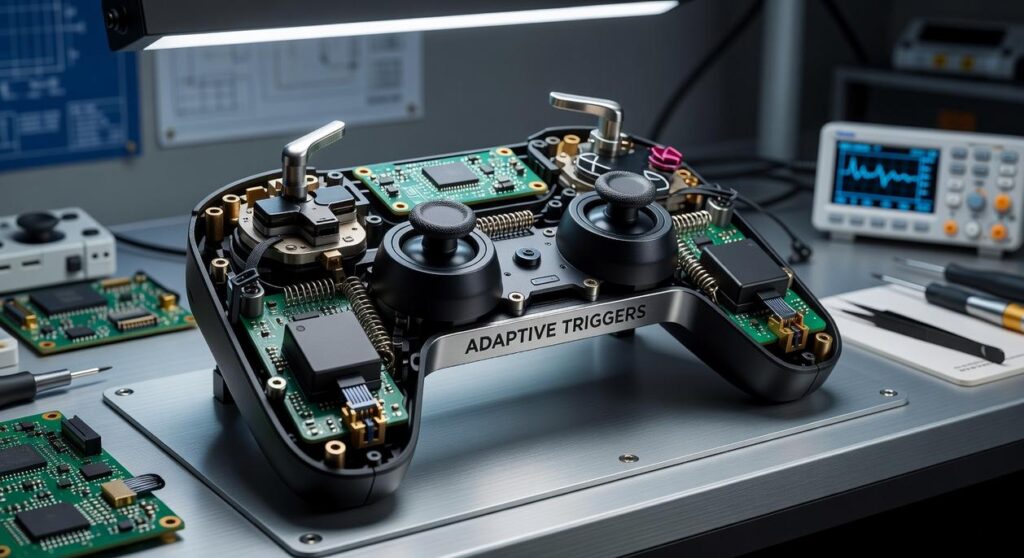
The real magic? Linear resonant actuators (LRAs). Before LRAs, we had this clunky thing called eccentric rotating mass (ERM) motors.
They were like the dinosaurs of vibration tech. Sure, they made controllers rumble, but it was a one-size-fits-all kind of buzz. LRAs changed the game with their precision.
They’re why you feel the pitter-patter of rain in a game instead of a generic rumble. This is where adaptive triggers come in.
Think about it. Adaptive triggers create that juicy tension when you’re pulling a bowstring or squeezing a trigger. How?
By adjusting the resistance on the fly. Like in the PS5 DualSense controller. You don’t just see the rain; you feel it.
Walking on sand? It’s more than a visual. It’s tactile.
This tech isn’t just fun; it’s a whole new dimension of gaming.
And if you’re wondering about the tech behind lithium batteries wireless gamepads explained, these updates are constantly evolving. Gamepads today are smarter, more responsive, and they bring a new level of immersion to gaming. Isn’t that what we’ve all been waiting for?
From Gimmick to Game-Changer: Haptics in Gaming
I’ve been gaming since before haptic feedback gamepads were a thing. Back then, controllers were just plastic shells with buttons. But now?
They’re alive. You feel it too, right? That immersive jolt when you fire a virtual gun or the subtle rumble as your car zips around a track.
It’s not just about the thrill, though. It’s about getting a competitive edge.
In first-person shooters, the haptic feedback transforms the experience. Imagine this: you’re in a firefight, and you can actually feel the difference between a shotgun’s hefty recoil and the rapid fire of a machine gun. The controller becomes an extension of your hand.
It tells you without looking that you’re ready to go again. Does it make you a better player? You bet.
And when you reload? That click you feel isn’t just cool. It’s strategic.
Switch gears to racing sims. Ever tried one with haptics? It’s a whole new world.
You sense the texture of the road, whether it’s smooth asphalt or gritty gravel. You feel the tires slipping, giving you a chance to correct and control. The jolt when you shift gears is not just a gimmick.
It’s information. You’re no longer just reacting; you’re anticipating. Feeling the road under your thumbs makes you a better driver.
Or at least, a more confident one.
Adventure and RPG games take it further. Here, haptics deepen your connection to the world. Picture prying open a chest; the tension in your hands feels real.
Or casting a spell. You sense it charging, the power building. It’s like holding magic.
These tactile cues pull you in, make the world richer. And when you’re in deep, you play smarter.
These sensory details matter. They’re not just flair. They’re valuable information.
They tell you what’s happening without needing to see it. Haptics make games more intuitive, more engaging. They bridge the gap between player and game.
Without them, you’re just pressing buttons. With them, you’re living the game. It’s a game-changer, plain and simple.
Titans of Touch: Exploring Today’s Leading Gamepads
Let’s cut through the noise. Everyone’s talking about haptic feedback gamepads, and for good reason. These aren’t just controllers anymore (they’re) extensions of the gaming world right into your hands.

Take the PlayStation 5 DualSense, for instance. It’s the go-to example when you want to see how far haptic feedback has come. The DualSense doesn’t just buzz; it talks back with its adaptive triggers and subtle vibrations.
Feel the tension in your bowstring or the crunch of gravel beneath your wheels. It’s like the game reaches out of the screen, pulling you in with force.
But wait, Xbox isn’t sleeping on the job. The Xbox Wireless Controller’s “Impulse Triggers” offer a different flavor of tactile feedback. Instead of broad vibrations, these triggers target specific fingers, bringing out fine details like recoil in shooters.
It might not be as flashy as the DualSense, but it’s got its charm. It works, especially if precision triggers are more up your alley. Let’s be real: different strokes for different folks.
Then there’s the third-party scene (enter) the high-end Razer or SCUF controllers. These come clutch with things like “HyperSense” haptics or tactile mechanical buttons. Razer definitely has a unique approach, trying to carve a niche right next to the industry giants.
With these controllers, you’re talking customizability and a personalized feel. They say, “Sure, the big players are cool, but have you tried this?”
So, where does that leave us? Gamepads aren’t just inputs anymore. They’re part of the gaming experience, shaping how we connect with our consoles.
If you’re curious about more than just feel. Like Bluetooth connectivity details (this) guide can tell you how it all ties together. With all these options, it’s about choosing what fits best in your hands.
The Future is in Your Hands: What’s Next for Haptic Technology?
Haptic technology is moving fast, and it’s not just for your phone anymore. We’re talking about full-body haptics here. Imagine wearing a vest that lets you feel every punch in a game or every beat in a virtual concert.
It’s not sci-fi; it’s happening. These vests and suits aim to give us total-immersion feedback. You know, that next-level experience where you start questioning what’s real.
Then there’s AI-driven haptics. This is where things get wild. AI can create changing tactile effects in real-time.
No more waiting for developers to pre-program every sensation. Just plug in your haptic feedback gamepads and let the AI do its magic.
So, what’s the endgame? A future where the line between physical and virtual blurs. Advanced sensory feedback will make us feel like we’re living in another world.
Are you ready for it? Because it’s closer than you think.
Feel the Game, Not Just Play It
I know it sounds like a luxury, but it’s not. Advanced tactile response is now important for true gaming immersion. Playing without it?
You feel disconnected, like you’re missing half the experience. Imagine being deep in your game world, every explosion, every crash felt. haptic feedback gamepads change the game. This technology isn’t just about specs; it’s about feeling every bit of your game.
So next time you’re shopping for a controller, think about how it feels. Want more immersion and control? Dive into hssgamepad.net and feel the future of gaming.
 Evan Taylorainser writes the kind of device integration strategies content that people actually send to each other. Not because it's flashy or controversial, but because it's the sort of thing where you read it and immediately think of three people who need to see it. Evan has a talent for identifying the questions that a lot of people have but haven't quite figured out how to articulate yet — and then answering them properly.
They covers a lot of ground: Device Integration Strategies, Tech Pulse Updates, HSS Peripheral Compatibility Insights, and plenty of adjacent territory that doesn't always get treated with the same seriousness. The consistency across all of it is a certain kind of respect for the reader. Evan doesn't assume people are stupid, and they doesn't assume they know everything either. They writes for someone who is genuinely trying to figure something out — because that's usually who's actually reading. That assumption shapes everything from how they structures an explanation to how much background they includes before getting to the point.
Beyond the practical stuff, there's something in Evan's writing that reflects a real investment in the subject — not performed enthusiasm, but the kind of sustained interest that produces insight over time. They has been paying attention to device integration strategies long enough that they notices things a more casual observer would miss. That depth shows up in the work in ways that are hard to fake.
Evan Taylorainser writes the kind of device integration strategies content that people actually send to each other. Not because it's flashy or controversial, but because it's the sort of thing where you read it and immediately think of three people who need to see it. Evan has a talent for identifying the questions that a lot of people have but haven't quite figured out how to articulate yet — and then answering them properly.
They covers a lot of ground: Device Integration Strategies, Tech Pulse Updates, HSS Peripheral Compatibility Insights, and plenty of adjacent territory that doesn't always get treated with the same seriousness. The consistency across all of it is a certain kind of respect for the reader. Evan doesn't assume people are stupid, and they doesn't assume they know everything either. They writes for someone who is genuinely trying to figure something out — because that's usually who's actually reading. That assumption shapes everything from how they structures an explanation to how much background they includes before getting to the point.
Beyond the practical stuff, there's something in Evan's writing that reflects a real investment in the subject — not performed enthusiasm, but the kind of sustained interest that produces insight over time. They has been paying attention to device integration strategies long enough that they notices things a more casual observer would miss. That depth shows up in the work in ways that are hard to fake.